
Knowing what to wear to court is one of those practical life skills that nobody teaches you until you actually need it, and by then the stakes are already high. Whether you are appearing as a defendant, a witness, a juror, or simply attending a hearing in support of someone else, what you wear to a court appearance sends an immediate and powerful message to everyone in that room — the judge, the jury, the attorneys, and anyone else present who is forming an impression of you before you say a single word.
Courts are formal institutional environments governed by specific behavioral expectations, and dress code is among the most visible expressions of whether you respect those expectations. Showing up in clothing that is too casual, too revealing, too informal, or simply inappropriate for a legal setting can affect how you are perceived and, in some contexts, can even affect the outcome of proceedings. Judges have been known to comment directly on inappropriate courtroom attire, and jurors form impressions based on appearance that are difficult to undo once established.
This guide covers what to wear to court comprehensively — for men, for women, for jury duty specifically, for different types of hearings, and for different levels of formality within the legal system. It also covers what to absolutely avoid, how to prepare your outfit, and the underlying principles that make courtroom dressing different from dressing for any other formal occasion.
1. Understand Why Courtroom Dress Code Matters
Before choosing what to wear to the court, it helps to understand the specific reasons why clothing choices carry real consequences in a legal setting rather than simply aesthetic ones.
Judges and attorneys are trained observers of human behavior, and appearance is part of the behavioral picture they read constantly throughout proceedings. A defendant who appears neatly dressed, groomed, and appropriately formal communicates respect for the legal process, awareness of the seriousness of the situation, and social competence. These are signals that affect credibility and perceived character in ways that are documented and acknowledged within the legal profession.
Jury perception operates on similar psychological principles. Research consistently shows that jurors form initial impressions of defendants and witnesses within seconds of seeing them, and that these impressions are influenced significantly by appearance and dress. A well-dressed, appropriately formal appearance does not guarantee favorable outcomes, but it removes a potential negative variable from a situation where every variable matters.
For jurors themselves, appropriate dress communicates respect for the civic responsibility of jury service and helps establish the respectful, neutral tone that judicial environments require.
The underlying principle across all courtroom contexts is the same: your clothing should communicate that you take this environment seriously, that you understand its formality, and that you are presenting yourself as a credible, composed, and respectful participant in the process.
2. General Rules for What to Wear to Court
Regardless of your specific role or the nature of the proceedings, certain foundational rules apply universally to courtroom attire. These are the non-negotiable principles that govern appropriate dress in any legal setting.
Dress at the Business Casual Level or Above
The minimum acceptable standard for courtroom dress is business casual. This means clothing that is clean, pressed, well-fitted, and clearly intentional in its formality. It means no jeans, no athletic wear, no casual t-shirts, no shorts, no flip flops, and nothing that reads as weekend or leisure clothing regardless of how expensive or well-made it is.
Business professional attire — a step above business casual — is always appropriate and in many courtroom contexts is the better choice. When in doubt between two options, always dress up rather than down in a legal setting. You will never be penalized for appearing too well-dressed in court. You can absolutely be penalized, formally or informally, for appearing not well-dressed enough.
Conservative Always Beats Trendy
Courts are traditional environments with deeply established norms and expectations. Trendy, fashion-forward clothing — even high-end designer pieces — can read as inappropriate or disrespectful in a courtroom context if they are too fashion-specific or too attention-grabbing. Classic, conservative, well-fitted clothing in neutral and dark tones always reads more appropriately than anything that calls attention to itself through style, cut, or current trend.
Clean, Pressed, and Well-Fitted
The condition of your clothing matters as much as the style. Wrinkled, stained, ill-fitting, or visibly worn clothing communicates carelessness and disrespect regardless of how appropriate the style itself might be. Everything you wear to court should be freshly laundered and pressed, in good repair, and fitted well enough that it does not pull, sag, or restrict natural movement.
Minimal and Understated Accessories
Accessories in a courtroom context should be simple, minimal, and understated. Large, bold, or conspicuous jewelry, accessories with logos or graphics, or anything that draws attention to itself is inappropriate for court. Simple watches, plain belts, small earrings, and minimal jewelry are all appropriate. Nothing should jingle, flash, or otherwise draw sensory attention during proceedings.
3. What to Wear to Court as a Man
Men’s courtroom attire follows relatively clear and established conventions. The standards are well-defined, the options are focused, and the margin for error is narrow in both directions.
The Suit Option
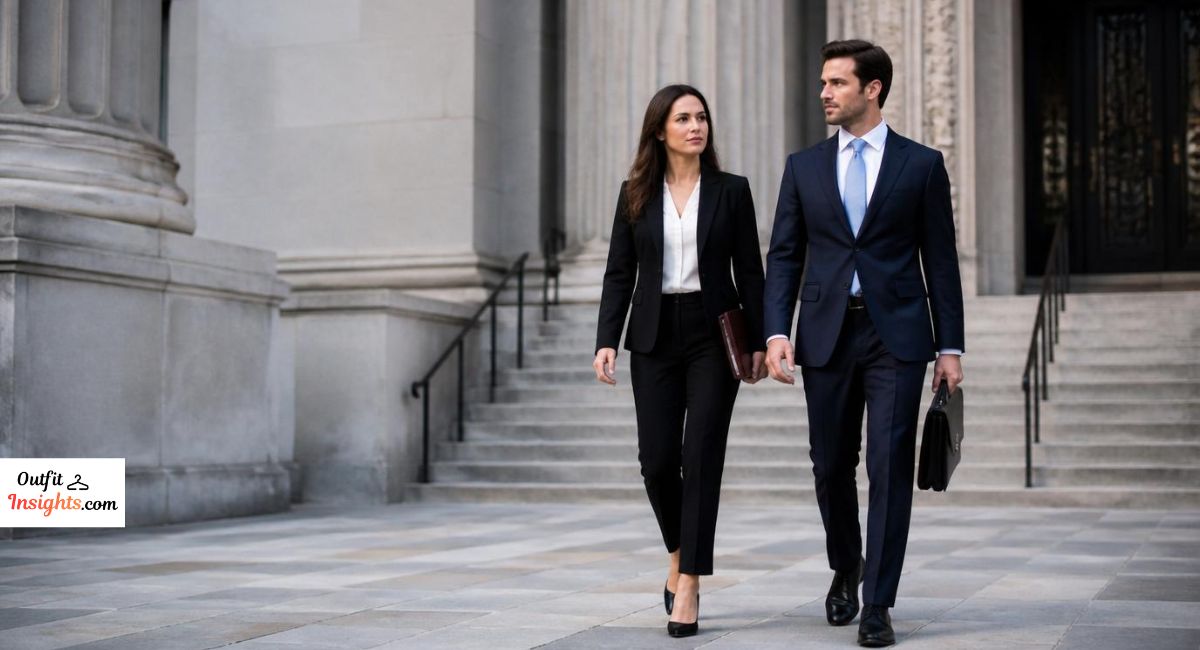
A well-fitted suit in a dark, conservative color is the strongest and most unambiguous choice for male courtroom attire across virtually every type of hearing and legal proceeding. Navy, charcoal, and dark grey are the most appropriate suit colors for court. They communicate formality, authority, and seriousness without being aggressive or attention-grabbing. Black suits are acceptable but can read as slightly funereal in some contexts — dark navy or charcoal is generally preferred.
The suit should fit correctly across the shoulders and chest, with trousers that break cleanly at the shoe. A suit that fits poorly — even if expensive and conservative in color — communicates carelessness in the same way that casual clothing does. The fit is not a secondary consideration.
Pair your suit with a dress shirt in white, pale blue, or a subtle, muted solid tone. The shirt should be freshly pressed with no visible wrinkles at the collar or cuffs. A conservative tie — solid color, subtle stripe, or understated pattern — completes the formal business professional look that is most appropriate for serious legal proceedings.
The Business Casual Option
For less formal hearings, traffic court appearances, or situations where a full suit would feel disproportionately formal, a blazer over dress trousers with a collared dress shirt is appropriate and widely accepted. The blazer provides structure and formality without the full weight of a suit. Trousers should be pressed dress trousers — not chinos, not khakis, not anything that reads as casual.
Leather dress shoes in black or dark brown complete the business casual look appropriately. Ensure shoes are clean and polished before a court appearance.
What Men Should Never Wear to Court
Jeans of any color, athletic shoes or sneakers, t-shirts or casual shirts without collars, shorts, athletic wear of any kind, clothing with visible logos or graphics, baseball caps or casual headwear, and anything visibly worn, stained, or in poor repair are all inappropriate for court and should never be worn to any legal proceeding regardless of how minor the matter seems.
4. What to Wear to Court as a Woman
What to wear to court as a woman involves a wider range of appropriate options than men face, but also more potential pitfalls. The greater variety of clothing options available to women means more ways to get it right — and more ways to inadvertently get it wrong.
Suits, Blazers, and Structured Dresses
A tailored pantsuit or skirt suit in a dark, conservative color is the most formal and most unambiguously appropriate option for female courtroom attire. Navy, charcoal, dark grey, and deep burgundy all work well. The suit should fit properly and be freshly pressed. A conservative blouse underneath in white, cream, or a muted solid tone completes the look appropriately.
A structured blazer over dress trousers or a pencil skirt is a strong business professional option that works well across most courtroom contexts. The combination is clearly formal, clearly intentional, and clearly respectful of the environment.
A conservative dress or skirt in a knee-length or longer cut is appropriate for women in courtroom settings. The dress should not be form-fitting to the point of being distracting, should have sleeves or allow for a blazer or cardigan layer, and should be in a solid color or a very subtle, understated pattern. Knee-length hemlines are the standard benchmark — anything significantly shorter is inappropriate for court.
Necklines, Hemlines, and Fit
Conservative necklines are essential. Necklines that are too low, too revealing, or too attention-grabbing are inappropriate for courtroom settings and can undermine the impression of seriousness and credibility you are trying to establish. A modest crew neck, boat neck, or closed V-neck is appropriate. A very deep V-neck is not.
Hemlines at or below the knee are the standard for court. Skirts or dresses that fall above mid-thigh are not appropriate for legal proceedings regardless of how fashionable they may be in other contexts.
Avoid anything form-fitting to the point of being distracting. Well-fitted clothing that skims the body cleanly is appropriate. Clothing that is extremely tight or that restricts natural, composed movement is not.
Shoes and Accessories for Women in Court
Closed-toe shoes in leather or a leather-like material are the most appropriate footwear for court. Low to medium heels or flat dress shoes both work well. Very high heels can create noise and draw attention in a way that is generally inappropriate for the quiet, composed environment of a courtroom. Sandals and open-toe shoes are not appropriate for formal legal proceedings.
Jewelry should be minimal and understated. Small earrings, a simple necklace, and a watch are all appropriate. Large, dangling, or attention-grabbing jewelry is not. The goal is to look polished and complete without looking as though you dressed for a social event rather than a legal one.
5. What to Wear to Jury Duty
Jury duty dress code follows the same general principles as courtroom attire for any other role, with a few specific considerations that are unique to the juror experience.
The Juror Context
As a juror, you are not appearing in a personal legal capacity. You are fulfilling a civic responsibility in a formal institutional environment. The appropriate attire reflects respect for that responsibility and for the legal proceedings you are participating in. Business casual is the widely accepted minimum standard for jury duty attire across most jurisdictions.
The specific expectations for jury duty dress vary somewhat by courthouse and jurisdiction, but the universal principle is the same: dress as you would for a professional work environment. If your workplace has a business casual dress code, that is the appropriate baseline. If your workplace is more formal, lean toward that level of formality.
What to Wear to Jury Duty for Women
For women reporting for jury duty, business casual attire is the standard recommendation. Dress trousers or a conservative skirt with a blouse and blazer, a conservative dress at knee length or below, or a smart separates combination that reads as professional are all appropriate. Comfortable footwear matters more for jury duty than for a brief court appearance because jurors can spend long days sitting, walking, and waiting — closed-toe flats or low heels in a leather material are practical as well as appropriate.
Avoid overly casual clothing even if the day involves a lot of waiting. Jeans, athletic wear, casual sandals, and graphic t-shirts are inappropriate for jury duty regardless of how long and physically uneventful the day turns out to be.
What to Wear on Jury Duty for Men
Men attending jury duty should dress at the business casual level as a minimum. Dress trousers with a collared shirt and optional blazer, or a full suit for those who prefer a more formal presentation, are both appropriate. Comfortable dress shoes matter for the same practical reasons as for women — jury duty days can be long, and you will be on your feet more than a typical court hearing involves.
The same prohibitions apply: no jeans, no athletic wear, no casual footwear, no graphic t-shirts, and no clothing that reads as inappropriate for a professional environment.
Jury Duty Dress Code by Formality Level
| Jury Duty Role | Minimum Appropriate Level | Ideal Level |
|---|---|---|
| Juror (standard) | Business casual | Business casual to business professional |
| Juror (high profile case) | Business professional | Business professional |
| Alternate juror | Business casual | Business professional |
| Grand jury | Business casual | Business professional |
6. What to Wear to Different Types of Court Hearings
The type of court hearing you are attending affects the appropriate level of formality within the general framework of conservative, professional dress.
Criminal Court
Criminal court proceedings — particularly anything involving serious charges, jury trials, or sentencing hearings — call for the highest level of formal, conservative dress available to you. A full suit for men and a tailored suit or structured formal dress for women is appropriate. The seriousness of criminal proceedings demands the most formal expression of your available wardrobe.
For defendants specifically in criminal proceedings, the goal is to appear as credible, composed, and respectful as possible. Research in legal psychology consistently shows that defendants who dress formally and conservatively are perceived more favorably by juries than those who appear casual or informal. This is not an ethical judgment about appearance-based bias — it is a practical reality of how human perception operates in high-stakes environments.
Civil Court
Civil court proceedings, including small claims court, family court, and civil litigation hearings, generally allow for a slightly less formal approach than criminal proceedings while still requiring clear professional dress. Business professional attire is still appropriate and recommended. Business casual is acceptable for minor civil matters like small claims hearings.
Traffic Court
Traffic court is among the least formal courtroom environments, but it is still a courtroom and still deserves appropriate dress. Business casual is the appropriate minimum. Showing up in casual or athletic clothing to traffic court may seem low-stakes, but it still communicates disrespect for the judicial environment and can affect how a judge perceives you when deciding how to handle your case.
Family Court
Family court proceedings — divorce, custody, child support, and related matters — are emotionally charged and often involve judges making character-based assessments of the parties involved. Appearance is particularly important in family court because the judge is actively forming impressions of your maturity, stability, and fitness. Business professional attire is strongly recommended for any family court appearance.
7. Colors That Work Best for Court Appearances
Color choices for courtroom attire follow clear principles that align closely with the formality and conservatism of the environment.
Dark, neutral tones are the most universally appropriate choices for court. Navy blue is widely considered the strongest single color choice for a courtroom appearance — it communicates trustworthiness, competence, and calm authority without being aggressive or attention-grabbing. Charcoal grey and dark grey are equally strong choices that communicate similar qualities.
Black is appropriate for court but works better as an accent or secondary tone than as a head-to-toe choice, which can read as overly severe or funereal in some contexts. Deep burgundy and forest green are acceptable for women in business professional contexts when worn as part of a tailored suit or structured outfit.
Avoid bright colors, neon tones, and anything heavily saturated for court appearances. Avoid pastels that read as too soft or casual for the gravity of the environment. Avoid bold patterns, large prints, and anything that draws visual attention to the clothing itself.
Court Outfit Color Guide
| Color | Appropriate for Court | Notes |
|---|---|---|
| Navy blue | Strongly yes | Most universally appropriate choice |
| Charcoal grey | Strongly yes | Authoritative and conservative |
| Dark grey | Yes | Clean and professional |
| Black | Yes with care | Avoid head-to-toe black |
| Deep burgundy | Yes for women | Best in suit or structured dress |
| Forest green | Yes for women | Conservative cut and fit required |
| White | Shirt or blouse only | Not appropriate as a primary outer color |
| Pastels | No | Too soft for formal legal setting |
| Bright or neon | No | Never appropriate for court |
| Bold patterns | No | Distracting and inappropriate |
Understanding how colors communicate different qualities in formal visual contexts connects directly to broader principles of color in professional settings, which our guide on What Colors Attract People’s Attention Most? Color Psychology for Stunning Photos covers in practical depth.
8. What Absolutely Not to Wear to Court
Knowing what not to wear to court is just as important as knowing what works. Certain choices are so consistently inappropriate that they warrant explicit mention.
Jeans are the single most common courtroom dress mistake. No matter how dark, how well-fitted, or how expensive, jeans read as casual in a legal setting and communicate that you did not take the appearance seriously enough to dress appropriately. Jeans are never acceptable for court regardless of the type of hearing.
Athletic wear — gym clothes, leggings worn as trousers, hoodies, athletic shoes, and training gear of any kind — is completely inappropriate for any court appearance. It communicates a level of casual disregard for the environment that can actively harm your credibility.
Clothing with visible logos, slogans, graphics, or political messaging is inappropriate for court. Logos draw attention to the brand rather than to you. Slogans and graphics introduce content that has no place in a judicial setting. Anything with political messaging is particularly problematic in an environment that is meant to operate as a neutral institution.
Revealing or form-fitting clothing that is inappropriate for a professional environment does not become appropriate for a courtroom. Very short hemlines, very low necklines, sheer fabrics, and anything that reads as evening or social occasion wear rather than professional attire are all inappropriate for legal settings.
Casual footwear — flip flops, athletic shoes, very casual sandals — communicates the same disrespect as casual clothing. Appropriate footwear is a complete part of an appropriate court outfit and should receive the same level of consideration.
For a broader understanding of how specific clothing choices affect the impressions you create in formal visual contexts, our guide on How to Look Good in Professional Photos: 12 Proven Tips covers the relationship between clothing choices and perceived professionalism in ways that apply directly to court appearances as well.
9. How to Prepare Your Court Outfit in Advance
Preparation is the difference between a court appearance where clothing supports your presentation and one where clothing creates an additional source of stress and distraction.
Plan and prepare your complete court outfit — including shoes, accessories, and any layers — at least two days before your appearance. This gives you time to address any problems you discover without the pressure of an imminent deadline. Press or steam everything the evening before. Check every garment for stains, loose threads, missing buttons, and any other issues that would compromise its appearance.
Try on the complete outfit, including shoes, and spend at least 15 minutes in it before the day of your appearance. Sit down, stand up, walk around. Ensure everything fits correctly in a seated position, which is where you will spend most of your time during a hearing. Clothing that fits well standing can behave very differently when seated, and you do not want to discover that during proceedings.
Lay out everything the night before and transport clothing on hangers where possible to minimize new wrinkles. Arrive at the courthouse with enough time to compose yourself before proceedings begin — rushing in at the last minute while worrying about your appearance is not the composed, confident presentation you are aiming for.
10. Court Attire and Its Connection to How You Are Perceived
The relationship between what you wear to court and how you are perceived is not superficial or arbitrary. It operates through well-documented principles of human psychology and social cognition that are worth understanding.
First impressions form within seconds and are disproportionately influenced by appearance, particularly in formal institutional contexts where behavioral norms are well-established and visible compliance with those norms is meaningful. A person who appears in court dressed appropriately has already communicated three important things before saying a word: they understood the expectations, they respected them, and they have the social and practical competence to meet them.
This does not mean that clothing determines legal outcomes. It means that clothing is one of many variables that affect the impressions of everyone in the room who has any influence on those outcomes, and it is one of the most controllable variables available to you. Making the right clothing choices removes a potential negative from a situation where you want every variable working in your favor.
Some occasions require dressing with respect rather than following current fashion trends. Just as court appearances call for modest and appropriate clothing, attending a wake also has its own expectations. Our guide on what to wear to a wake explains suitable outfits, colors, and etiquette for paying your respects.
The principles that govern courtroom dress connect to broader principles of how presentation affects professional perception in any formal context. Our guide on How to Pose for Pictures Naturally (2026): Stop Looking Awkward in Photos explores how physical presentation, composure, and appearance interact to create overall impressions of confidence and credibility that are relevant in courtroom contexts as well as photographic ones.
FAQs: What to Wear to Court
Court appearance dress questions come up consistently across all types of legal situations. The following answers address the most common questions directly.
1. What is the best thing to wear to court?
A well-fitted suit in navy or charcoal grey is the strongest choice for men across virtually all courtroom contexts. For women, a tailored suit, structured blazer with dress trousers or a knee-length skirt, or a conservative knee-length dress are all strong choices. The universal principle is clean, pressed, well-fitted, and conservative business professional attire in dark, neutral tones.
2. Can you wear jeans to court?
No. Jeans are never appropriate for court regardless of how dark, fitted, or expensive they are. Jeans read as casual in any legal setting and communicate a lack of respect for the formality of the environment. Always wear dress trousers or a conservative skirt instead.
3. What should a woman wear to court?
Women should wear a tailored pantsuit or skirt suit, a structured blazer with dress trousers or a pencil skirt, or a conservative knee-length dress in a dark, neutral color. Necklines should be modest, hemlines at or below the knee, and footwear should be closed-toe in a professional style. Accessories should be minimal and understated.
4. What should you wear to jury duty?
Business casual is the minimum appropriate standard for jury duty. Dress trousers with a collared shirt for men, and dress trousers or a conservative skirt with a blouse and optional blazer for women. Comfortable closed-toe footwear is practical given the length of jury duty days. Avoid jeans, athletic wear, and anything that reads as casual or informal.
5. What colors are appropriate for a court appearance?
Navy blue, charcoal grey, and dark grey are the most universally appropriate colors for court. Deep burgundy and forest green are acceptable for women in tailored, structured clothing. Avoid bright colors, neon tones, pastels, and bold patterns. White is appropriate as a shirt or blouse underneath darker outer clothing but not as a primary outer color.
6. Can you wear black to court?
Yes, black is appropriate for court. Dark charcoal or navy is generally preferred over head-to-toe black, which can read as overly severe in some contexts, but a black suit or black conservative dress is entirely acceptable. Pair black outer clothing with white or a light-colored shirt or blouse to avoid a completely monochromatic appearance.
7. How formal should you dress for traffic court?
Traffic court is the least formal courtroom environment but still requires appropriate dress. Business casual is the appropriate minimum. Dress trousers, a collared shirt, and clean dress shoes for men. A conservative blouse with dress trousers or a modest skirt for women. No jeans, athletic wear, or casual clothing regardless of how minor the matter appears.
8. What should you never wear to court?
Jeans, athletic wear, graphic t-shirts, shorts, flip flops, casual sandals, revealing or form-fitting clothing, anything with logos or slogans, bold or busy patterns, and any clothing that reads as casual, informal, or socially inappropriate for a professional environment. If you are unsure whether something is appropriate, choose something else.
Dressing appropriately for court is one of the most practical and actionable things you can do to present yourself in the best possible light during legal proceedings. As noted by the American Bar Association, courtroom decorum — which includes appropriate dress — is considered a fundamental expression of respect for the legal system and can materially affect how proceedings unfold. The effort invested in choosing and preparing the right court outfit is always worthwhile.