

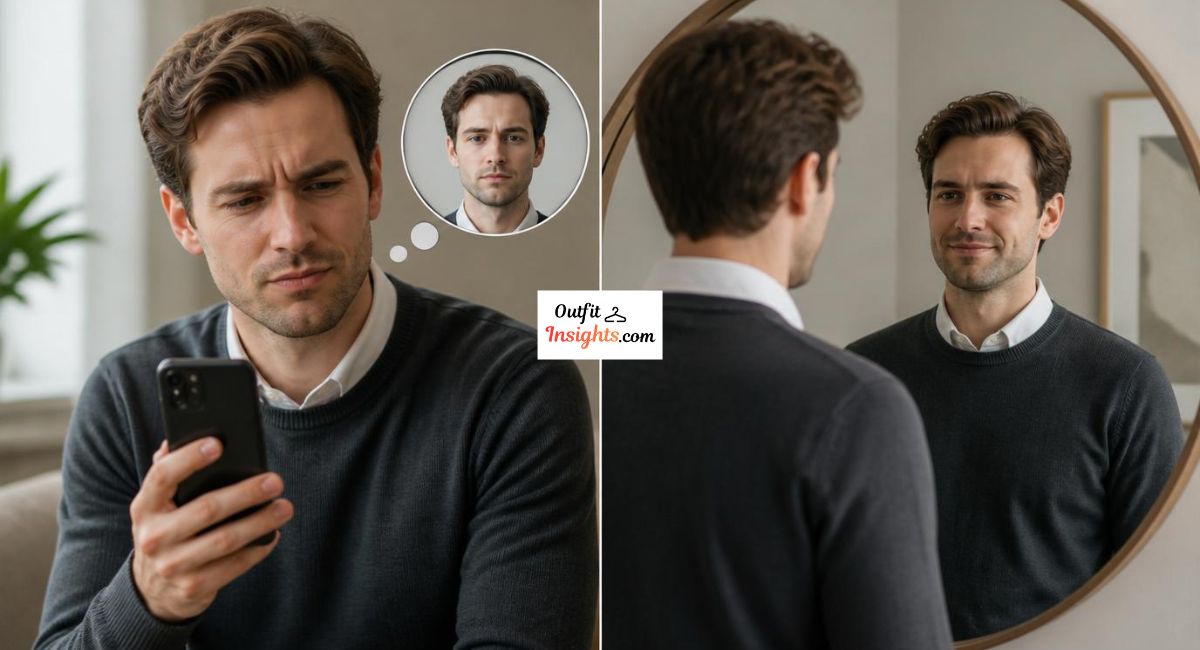
You look in the mirror before leaving the house and feel reasonably good about how you look. Then someone shows you a photo taken an hour later and your immediate reaction is some version of confusion, disappointment, or outright rejection. That cannot be what I actually look like. That reaction, that specific disconnect between how you feel you look in person and how you appear in photographs, is one of the most universal and most psychologically fascinating experiences of modern life. Almost everyone has it. Almost nobody understands why.
The answer is not that you are unattractive. It is not that cameras are broken. And it is definitely not that the people who tell you that you look great in photos are lying to be kind. The real explanation involves a genuinely fascinating intersection of perceptual psychology, optical physics, neuroscience, and the specific way human beings build their sense of what they look like. Once you understand these mechanisms clearly, the disconnect between your mirror experience and your photo experience stops feeling like a personal failing and starts making complete logical sense.
This article covers every major scientific and psychological reason why you hate photos of yourself, why other people consistently think those same photos look great, what is actually happening inside your brain when you look at an image of yourself, how camera technology contributes to the problem, and what you can practically do to change your relationship with your own photographs.
1. The Mere Exposure Effect: Why Your Mirror Face Feels Like the Real You
The single most important psychological concept for understanding why you hate photos of yourself is the mere exposure effect, and it explains more about this phenomenon than almost any other factor.
What the Mere Exposure Effect Is
The mere exposure effect is a well-documented psychological phenomenon first identified by psychologist Robert Zajonc in 1968. Its core finding is straightforward and profound. Human beings develop a preference for things simply by being exposed to them repeatedly. Familiarity does not just breed comfort. It breeds genuine positive feeling, attraction, and a sense that the familiar thing is correct, right, and good.
This effect operates across every domain of human experience. It applies to music, to food, to places, to people, and very specifically to faces. The more you see a face, the more attractive and appealing that face feels to you. This is not a conscious evaluation. It is an automatic, deeply wired perceptual response.
How This Applies Directly to You and Your Photos
You have seen your own face more than any other face in your entire life. Every morning in the bathroom mirror. Every time you wash your hands. Every reflective surface you pass. Every time you apply makeup, style your hair, or check your appearance before a meeting or a date. Over years and decades of daily exposure, your brain has built an extraordinarily deep and stable preference for a very specific version of your face.
Here is the critical detail. The version your brain has become deeply familiar with through all those mirror reflections is not actually how your face looks to other people. It is the mirror reversed version of your face. A horizontally flipped image. Because no human face is perfectly symmetrical, the mirror version and the camera version of your face are subtly but meaningfully different from each other. And because your brain has spent years deciding that the mirror version is the correct, familiar, and therefore attractive version of your face, the camera version, which is actually closer to how everyone else sees you every single day, feels wrong.
When you look at a photo of yourself and feel that immediate sense of wrongness or disappointment, what you are experiencing is your brain rejecting an unfamiliar version of something it has very strong established preferences about. The rejection feels like an aesthetic judgment. Actually it is a familiarity response.
Why Everyone Else Prefers the Photo Version
Here is the counterintuitive and ultimately reassuring part of the mere exposure effect as it applies to your photos. Other people have the exact opposite familiarity relationship with your face that you do.
Your friends, family, colleagues, and anyone else who knows you has spent their entire time with you looking at the camera version of your face, the non-reversed version. That is what you look like to them in every conversation, every social interaction, every shared experience. They have built their familiarity and their preference around the photo version of you. So when they look at a photograph of you, their brain says yes, that is exactly right, that is exactly what this person looks like. They respond positively not because they are being generous but because the photo genuinely matches their deeply familiar version of your face.
A landmark study by Mita, Demer, and Knight published in 1977 demonstrated this phenomenon directly. Participants were shown two versions of their own face, the mirror image they were familiar with and the true photographic image that others saw. They consistently preferred the mirror version. Their close friends, shown the same two images, consistently preferred the photographic version. Both groups were responding to familiarity, and both groups were right within their own perceptual framework.

2. Camera Lens Distortion: The Physics of Why Photos Look Wrong
Beyond psychology, there is a genuine physical and optical reason why photographs do not accurately represent how you look in three-dimensional real life, and understanding this removes a significant amount of the self-criticism that photo-hating generates.
How Camera Lenses Distort Facial Proportions
Cameras, and particularly smartphone cameras, use lenses with relatively short focal lengths to capture images. The physics of short focal length lenses creates a phenomenon called perspective distortion, where features closer to the lens appear proportionally larger than features further away. When a camera is held at close range, such as during a selfie or a casual group photo, your nose appears slightly larger, your forehead slightly more prominent, and your overall facial proportions appear subtly but meaningfully different from how they actually look at normal conversational distances.
Research published in the journal JAMA Facial Plastic Surgery found that selfies taken at a distance of 12 inches distorted the nose to appear approximately 30 percent wider than it actually appears at a conversational distance of five feet. This is not your nose. This is lens physics doing something to your nose. The difference between how your face looks at 12 inches on a phone camera versus how it looks at a five-foot conversational distance is not a camera-caught truth about your appearance. It is an optical artifact of focal length.
Professional photographers understand this and compensate by shooting portraits with longer focal length lenses from greater distances, which dramatically reduces perspective distortion and produces images that look much closer to how the subject appears in person. The flattering quality of professional portraits is not magic. It is focal length physics applied correctly.
The 2D Flattening Problem
A photograph captures a three-dimensional face in two dimensions. This flattening loses meaningful information about your actual appearance that human eyes and brains naturally reconstruct in real life. Depth, the way light plays across three-dimensional facial contours, and the natural volume of your features all exist in three dimensions in person but are compressed into a flat plane in a photograph.
This compression can make features that look perfectly proportioned in three dimensions appear slightly different in two dimensions because the spatial relationships between features change when depth is removed from the equation. Your face in person has dimension and shadow and light that your face in a flat photograph simply cannot fully represent.
Lighting: Why Cameras Cannot See What Your Eyes See
Human vision is extraordinarily adaptive. Your visual system continuously adjusts to different lighting conditions, compensating for harsh shadows, blown-out highlights, and uneven illumination in ways that make every environment look reasonably balanced and natural to you. Camera sensors cannot do this. They capture a fixed exposure at a single moment, which means that harsh overhead light creates unflattering downward shadows, flash photography can flatten facial features and add years to your appearance, and mixed lighting environments produce color casts and contrasts that your eyes never actually saw but your camera captured faithfully.
When a photo looks harsher, flatter, or more unflattering than you feel you look in person, the lighting captured by the camera is a significant contributing factor that has nothing to do with your actual appearance.

3. The Frozen Face Effect: Why Expressions Look Wrong in Photos
One of the least discussed but most significant reasons people hate photos of themselves is what researchers call the frozen face effect. Understanding this phenomenon changes how you interpret every unflattering candid photograph you have ever seen of yourself.
How Your Face Communicates in Real Life
In real life, your face is never still. Micro-expressions, subtle muscle movements, shifts in eye focus, the natural animation of breathing and thinking and responding all create a continuously moving, living visual experience of your face that is central to how other people perceive and respond to you. Your attractiveness, warmth, intelligence, and personality all communicate through this constant movement. People who know you do not experience your face as a series of still images. They experience it as a dynamic, expressive, living presence.
When people tell you that you are more attractive in person than in photos, this is almost always what they are responding to. The animation of your real face, the way your eyes change when you laugh, the micro-expressions that communicate your personality in real time, the warmth that comes through in the natural movement of your features. All of this is invisible in a photograph.
What a Camera Actually Captures
A camera captures a single millisecond of your face. One frozen frame out of the continuous film of your actual expression. And here is the statistical reality of that. Most of the time, that single millisecond does not coincide with a particularly representative or flattering moment of your expression. Your natural face in motion has many beautiful moments that the camera misses for every one it happens to catch.
Professional photographers take hundreds of frames and select the single best one. When you see an unflattering candid photograph of yourself, you are seeing one randomly selected millisecond of your face that happens to be unrepresentative of how you actually look the vast majority of the time.
Additionally, people tend to stiffen when they know a camera is present. The awareness of being photographed triggers a self-monitoring response that creates subtle muscular tension in the face that is not present in natural expression. This tension shows in photographs as a slight stiffness or inauthenticity that is entirely absent when you are simply living your life and being yourself. Our guide on how to pose for pictures naturally covers specific techniques for overcoming exactly this camera-induced tension and capturing genuinely natural expressions.

4. Self-Enhancement Bias: The Psychology of How You See Yourself
Self-enhancement bias is a well-documented cognitive phenomenon that adds another layer to understanding why you hate photos of yourself, and it operates in a somewhat counterintuitive direction from what you might expect.
What Self-Enhancement Bias Is
Self-enhancement bias is the consistent human tendency to evaluate our own traits and abilities more favorably than objective evidence warrants. Applied to physical appearance, it means that most people carry a mental image of themselves that is slightly more attractive than their objective appearance, because memory and self-perception are not passive recordings but active constructions that are systematically biased toward favorable self-representation.
Research by Epley and Whitchurch published in 2008 demonstrated this directly. Participants were shown a lineup of photographs including their true image and versions that had been digitally altered to be more or less attractive. Participants consistently identified the more attractive altered versions as the real photographs of themselves. They believed they looked better than they actually did.
Why This Creates Photo Disappointment
When you encounter a photograph of yourself, it presents an unfiltered, objective record that your self-enhancement bias cannot edit or improve. The photograph shows you what you actually look like in the specific moment and lighting conditions it was taken, without the favorable cognitive editing your brain automatically applies to your self-image. The gap between your favorably biased self-image and the unfiltered photographic record creates disappointment that feels like the photo is wrong, when actually the bias is showing you the discrepancy between your expectation and reality.
This is not a personal failing or a sign of vanity. It is a universal human cognitive mechanism. Studies consistently show that most people overestimate their own attractiveness to a moderate degree, and that this overestimation is positively associated with psychological wellbeing. The bias exists partly because it helps us maintain the confidence needed to pursue social connections, take risks, and function effectively in the world.
The Important Flip Side
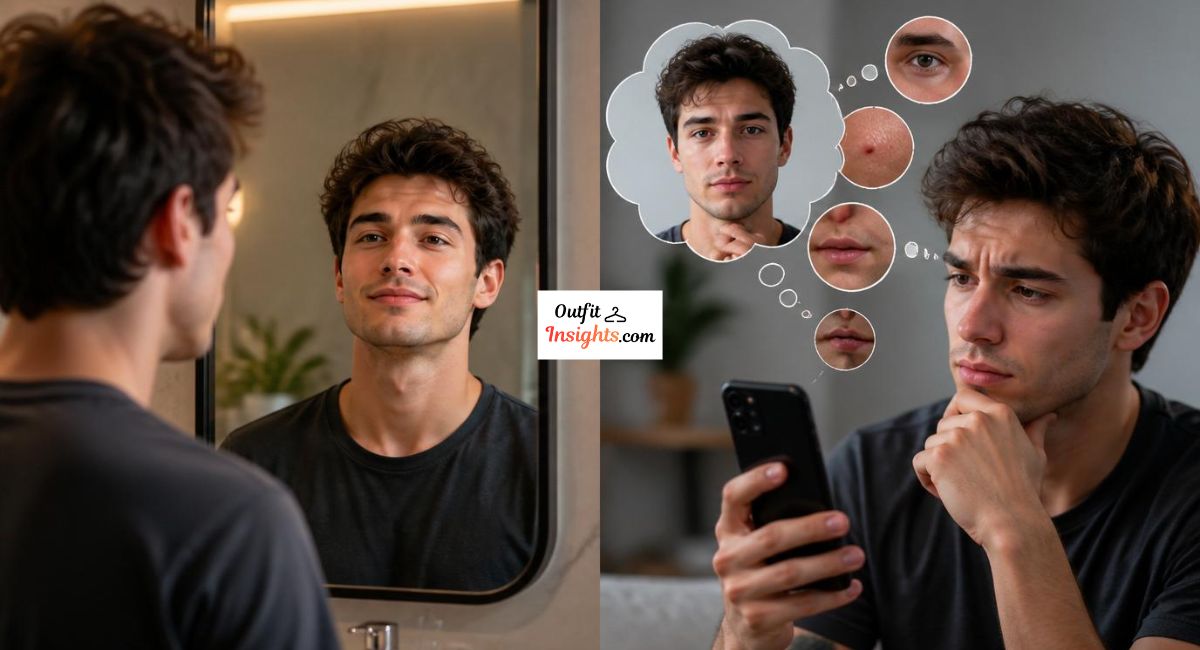
The same self-enhancement bias that makes you disappointed in photos also means that your perception of your own flaws is systematically exaggerated. When you look at a photograph of yourself and focus intensely on specific features you dislike, you are applying a magnifying lens to perceived imperfections that other people genuinely do not notice or weight in the same way.
Other people see your photograph as a complete, holistic image of a person. You see it as a series of specific features to be evaluated individually and critically. This difference in visual processing is not a reflection of reality. It is a reflection of the specific and highly personal relationship you have with your own appearance.
5. Confirmation Bias and Negative Self-Image
Beyond self-enhancement bias, confirmation bias plays a specific and powerful role in how you process images of yourself, and it creates a self-reinforcing cycle that makes photo-hating a habitual rather than simply a reactive response.
How Confirmation Bias Works in Photo Self-Evaluation
Confirmation bias is the tendency to search for, interpret, and remember information in a way that confirms pre-existing beliefs. Applied to photographs of yourself, it means that if you have decided that you are not photogenic, you will look at every photograph through that lens and find evidence that confirms the belief, while discounting or ignoring evidence that contradicts it.
You will notice the one photo where your expression looks awkward and remember it as representative of all photos of yourself. You will scroll past the five photos where you look great without registering them as meaningful data. You will compare your photos to the most flattering professional images of other people and conclude that you look worse, rather than recognizing that you are comparing your worst moments to other people’s carefully curated best moments.
The Social Media Distortion Factor
Social media has created an entirely new dimension of photo self-evaluation that did not exist for previous generations and that significantly amplifies the negative self-perception that photos can trigger. The images people encounter constantly on social media are not representative of how real people actually look in photographs. They are the most heavily filtered, most carefully lit, most expertly posed, and most extensively edited images selected from hundreds of attempts.
When you compare a candid photo of yourself to the images in your social media feed, you are not comparing like with like. You are comparing an unfiltered real moment with a heavily curated highlight reel that has been specifically engineered to meet an increasingly narrow and increasingly unrealistic standard of photographic appearance. This comparison is inherently unfair and inherently generates a false conclusion about your own appearance.
The unrealistic standard that social media creates affects how we evaluate photos of ourselves at a deep perceptual level. Our guide on why some people look more photogenic than others explains the specific factors that create photogenic appearance in images and why the concept of being naturally photogenic is far more nuanced and learnable than most people assume.

6. The Voice Recording Parallel: You Are Not Alone in This
One of the most useful reframes for understanding why you hate photos of yourself is the parallel experience of hearing your recorded voice for the first time. Almost universally, people dislike the sound of their recorded voice. It sounds wrong, higher or lower than expected, unfamiliar and slightly alien. The reaction is often stronger than the photo discomfort and the underlying psychology is identical.
Your voice as you experience it internally travels partly through bone conduction in your skull, which changes its frequency and resonance in ways that feel natural and correct to you but that no one else hears. When you hear a recording, you are hearing your voice as everyone else hears it. Your initial reaction of that does not sound like me is factually wrong. That is exactly what you sound like to everyone who has ever spoken to you. But it feels wrong because it is unfamiliar.
The photo experience is the same mechanism. The camera version of your face feels wrong because it is unfamiliar. It is not less accurate than your mirror version. In many ways it is more accurate, because it shows what other people actually see. The wrongness you perceive is a familiarity response, not an accuracy assessment.
Understanding this parallel removes a significant amount of the emotional weight from photo discomfort. You do not conclude from hating your recorded voice that you actually have a terrible voice and everyone is too polite to tell you. You understand it as a perception artifact. The same reasoning applies perfectly to photographs.
7. Why Other People Think Your Photos Look Great
Understanding the specific reasons why other people respond positively to photographs of you that you find disappointing or unflattering closes the logical loop and completes the picture of what is actually happening.
They Are Seeing Their Familiar Version of You
As established through the mere exposure effect, people who know you have spent all their time with you seeing the camera version of your face. Your photo is not a strange or unfamiliar representation to them. It is exactly the version of you they know, like, and associate with the positive experiences and feelings they have about you. Their positive response to your photo is a genuine reflection of genuine familiarity and genuine positive feeling.
They Process You Holistically, Not Critically
When a friend looks at a photo of you, they see you. They do not see a collection of individual features to be evaluated critically. They see a complete image of a person they have positive associations with, and that holistic positive impression shapes how every detail of the image is perceived. The specific feature you focus on and dislike in the photo is genuinely invisible to them within the larger context of seeing you as a whole person they care about.
They Are Not Comparing You to an Unrealistic Standard
Your friends are not looking at your photographs and comparing them to heavily filtered social media images or professional photography. They are looking at a photo of you and comparing it to their existing mental image of you, which is built from real-world interactions in real lighting under real conditions. That comparison is inherently fair and inherently favorable in a way that your own self-critical comparison process is not.
They Are Seeing Your Personality Through the Image
Even in a still photograph, people who know you well see your personality through your features. They read your expression through the lens of everything they know about you and they see the warmth, the humor, the intelligence, or the kindness that they associate with you. You look at the same image and see a frozen, unfamiliar face. They look at it and see you. The difference is context, familiarity, and the powerful effect of positive relationship on visual perception.
8. What You Can Actually Do About It
Understanding the science behind why you hate photos of yourself is genuinely useful, but practical strategies for improving your relationship with your own photographs are equally important.
Increase Your Exposure to the Camera Version of Yourself
The mere exposure effect works in both directions. Just as repeated exposure to your mirror version created your preference for it, repeated and intentional exposure to the camera version of yourself will gradually build familiarity and therefore positive feeling toward it. This does not mean taking obsessive selfies. It means consciously choosing not to immediately dismiss or delete every photo of yourself, and giving yourself regular opportunities to see the camera version of your face without immediately evaluating it critically.
Over time, the camera version becomes more familiar and therefore more acceptable to your brain. Many people who initially hated photos of themselves report that after taking more photographs and looking at them more regularly, their discomfort decreased significantly. The science supports this experience entirely.
Focus on Expression and Animation Rather Than Appearance
The most photogenic people are not necessarily the most conventionally attractive people. They are the people whose genuine emotion and personality come through most powerfully in a still image. The key to this is not controlling your expression but releasing it. When you are genuinely laughing, genuinely engaged, genuinely emotional, photographs capture something that transcends the static limitations of the medium and communicates real life.
Photographs that you look at and feel warmth toward are almost never technically perfect images. They are emotionally resonant ones. Pursuing genuine expression rather than controlled appearance in photographs produces consistently better results and consistently better feelings about the images afterward.
Understand What a Good Photo Actually Requires
Most unflattering photographs of non-professional subjects are unflattering not because of how the subject looks but because of how the photograph was taken. Poor lighting, wide-angle lens distortion, an unrepresentative frozen expression, an unflattering angle. All of these are photography problems rather than appearance problems.
Learning the basics of what makes a photograph flattering, specifically the role of lighting, lens choice, distance, and angle, changes how you interpret unflattering images of yourself. Instead of concluding I look terrible, you begin to recognize I was photographed in terrible light at a terrible angle with a wide-angle lens at close range. Those are completely different conclusions with completely different implications for how you feel about your appearance.
Our guide on how to take good pictures by yourself covers the specific practical techniques that produce consistently flattering self-photographs, and understanding these mechanics changes your relationship with your own images significantly.
Separate Self-Worth From Photogenic Quality
Being photogenic is a specific and learnable skill set that has limited relationship to overall attractiveness or appearance. Many people who are genuinely beautiful in person are not naturally photogenic because they have not learned how to translate their three-dimensional, animated, living attractiveness into the specific requirements of a still two-dimensional image.
Being not photogenic means you have not yet learned to translate your real appearance into photograph form. It does not mean you are less attractive than people who have. Once you understand photogenic quality as a skill rather than an inherent trait, the emotional weight of being unhappy with your photographs diminishes considerably. For a deeper exploration of the specific factors that create photogenic quality and how they can be learned and developed, our guide on why you are not photogenic but look good in person covers this topic in comprehensive practical detail.
9. The Relationship Between Self-Perception and Fashion Confidence
The psychology of hating your photos connects directly to broader questions of how you present yourself, choose your clothing, and build confidence in your overall appearance. Understanding the perceptual gap between your self-image and how others see you has practical implications for how you dress and style yourself.
Many people make clothing and styling choices based on how they perceive themselves in mirrors, which as we have established is a systematically biased and familiarity-distorted version of their appearance. When you understand that other people see a genuinely different and in many ways more complete version of you than your mirror provides, it changes how you might think about the visual impression you create.
The colors, fits, and styling choices that look right to you in a mirror and the choices that look best in photographs and in person to others can differ in meaningful ways. Understanding color behavior in photography, for example, is directly relevant to anyone who has ever looked at a photo of themselves in a perfectly nice outfit and wondered why it looks different than it did in the mirror. Our guide on what color is most flattering for photos covers exactly this intersection between color choice, self-perception, and photographic appearance in practical detail.
FAQs: Why You Hate Photos of Yourself
Understanding why you dislike photos of yourself involves a combination of psychology, perception, camera optics, and self-image. The frequently asked questions below address the most common concerns people have about looking different in photos, feeling unphotogenic, and understanding how others actually see them.
1. Why do I look so different in photos compared to real life?
You look different in photos for several simultaneous reasons. Your mirror shows a horizontally reversed image that your brain has developed a strong familiarity preference for over years of daily exposure. Camera lenses, particularly smartphone wide-angle lenses, create perspective distortion that alters facial proportions. Photos freeze a single millisecond of expression rather than capturing the continuous animation that defines your real appearance. And the two-dimensional flattening of photography removes the depth and dimensionality that makes faces look most natural and three-dimensional. None of these mean the photo is wrong. They mean photos and mirrors are simply different representations of your appearance.
2. Is the photo or the mirror a more accurate representation of how I look?
Neither is perfectly accurate. Your mirror shows a reversed, three-dimensional, self-directed image in familiar lighting that your brain has spent years developing a preference for. Your photo shows a non-reversed, two-dimensional image that may have lens distortion and lighting artifacts. The photo version is closer to what other people see when they look at you in daily life. The mirror version is what your brain has decided you look like through familiarity and preference. Other people prefer the photo version because it matches their familiarity with you. You prefer the mirror version for the same reason.
3. Why do other people think my photos look great when I hate them?
Other people think your photos look great because they have built their familiarity and preference around the camera version of your face, which is the version they see every time they interact with you. They process your image holistically rather than critically, they see your personality and the positive associations they have with you through the photograph, and they are not comparing your image to an unfairly edited or idealized standard. Their positive response is genuine and based on the same psychological mechanisms that explain your negative response from the opposite direction.
4. What is the mere exposure effect and how does it relate to photos?
The mere exposure effect is a psychological phenomenon documented by Robert Zajonc in 1968 that describes how human beings develop preferences for things simply through repeated exposure. Applied to photographs of yourself, it means your brain prefers your mirror image because you have seen it every day for your entire life, and finds the camera version of your face subtly wrong-feeling simply because it is less familiar. The effect also explains why other people prefer the camera version of your face, because that is the version they have repeatedly seen in all their real-life interactions with you.
5. Can you become more comfortable with photos of yourself over time?
Yes, absolutely and for a specific scientific reason. The mere exposure effect works in both directions. The same psychological mechanism that created your preference for your mirror image over time will gradually create more comfort with your camera image if you expose yourself to it more regularly and more intentionally. People who take more photographs of themselves and consciously avoid the immediate delete reflex consistently report becoming more comfortable with their photographic appearance over time. The discomfort is rooted in unfamiliarity and familiarity is something that changes with exposure.
6. Does camera lens distortion really make a meaningful difference in how I look?
Yes, particularly with smartphone cameras. Research has documented that wide-angle smartphone lenses at close range can make the nose appear up to 30 percent wider than it appears at a normal conversational distance. This is not how you actually look. It is an optical artifact of the lens and shooting distance. Professional photographers use longer focal length lenses from greater distances specifically to eliminate this distortion, which is why professional portraits consistently look more flattering and more natural than casual selfies taken at arm’s length.
7. Why do I look good in candid photos sometimes but hate posed ones?
Candid photographs capture genuine expression and natural animation that posed photographs frequently lack. When you are genuinely engaged, laughing, or emotionally present, your face communicates that animation even within the frozen frame of a photograph. When you are posed and aware of the camera, subtle muscular tension creates a slight stiffness or inauthenticity that is immediately visible in the final image. The candid photos you love are the ones where your genuine self came through despite the camera’s presence. The posed ones you hate are often the ones where your awareness of being photographed created the tension that shows in the final image.
Hating your photos while knowing other people find them perfectly fine is not a vanity issue or a self-confidence issue. It is a perception issue rooted in deeply understood and well-documented science. Your mirror face feels like the real you because familiarity creates preference. Your camera face feels wrong for the same reason. But the camera face is what everyone who has ever cared about you has been looking at all along, and they have been doing so with genuine affection and genuine positive feeling. According to Psychology Today, the mere exposure effect is one of the most robustly replicated findings in all of social psychology, which means the explanation for your photo discomfort is not just plausible theory but one of the most well-established principles in the science of human perception. The photo is not wrong. Your brain is simply more familiar with a different version of you.